

3 Reasons to Practice Yoga Nidra in the Morning
Can you practice yoga nidra in the morning, and what is the best time of day to do a yoga nidra session are the most commonly asked questions I receive as a yoga nirdra teacher. This post will explain three reasons why you should try a morning yoga nidra practice to feel more rested and have an amazing day.

Table of contents
What is yoga nidra
Although you may not hear it often, yoga nidra is actually three things.
Most commonly known, yoga nidra is a practice. An ancient practice of meditation that is traditionally guided in steps that lead you through the subtle bodies, aka, the pancha maya koshas.
This is a gentle practice that is known as a practice of non-doing, so there is actually no movement or “poses” involved in the practice.
Yoga nidra is effortless in a way that your body already knows how to do what you are being guided to do. It leads you gently to a place where the mind is awake and the body is asleep. Your body already knows how to enter into a state of sleep, so this practice brings benefits to even first-time practitioners. This sleep-like state you enter into with yoga nidra is called the hypnogagic state.
As a practice, yoga nidra is also known as yogic sleep. It is also a form of NSDR which stands for non-sleep deep rest, a modern term coined by Dr. Andrew Huberman.
Secondly, the practice of yoga nidra, traditionally, is designed to lead you into the state of yoga nidra. Which is the state of turiya. Turiya is the state in which we are existing as our True self or Atman. While this may not be the modern yoga nidra practitioner’s goal, nonetheless you have the opportunity to experience this each time you practice yoga nidra.
Thirdly yoga nidra is a goddess. She is the goddess in the Devīmāhātmya, and in this story, she is called upon to awaken Vishnu so that he can fight two Asuras.
To sum this up, yoga nidra is a practice with ancient roots that can help you start to bridge the gap from where you are to where you want to be. Whether you are seeking this deep relaxation practice for the benefits of stress release, feeling grounded, regulating your nervous system, or creating the ultimate connection to your True Self, yoga nidra can help you do this.

How yoga nidra is different than meditation
Yoga Nidra and meditation are both practices that promote relaxation, self-awareness, and overall well-being, but they differ in their approaches and goals. A few differences in the practices include:
Technique:
- Yoga Nidra: Yoga Nidra is often practiced lying down in a comfortable position. The practitioner is guided through a series of instructions to enter a state of deep relaxation while maintaining awareness.
- Meditation: Meditation techniques can vary widely, but common practices involve sitting comfortably in a seated position and focusing the mind on a specific object, mantra, breath, or bodily sensation. The aim is to achieve a state of focused attention and mindfulness.
Purpose:
- Yoga Nidra: The primary purpose of Yoga Nidra is to induce deep physical, mental, and emotional relaxation. It is often used as a tool for stress reduction, healing, and personal transformation.
- Meditation: The purpose of meditation can be diverse, depending on the specific technique or tradition. Some common objectives include gaining insight, cultivating mindfulness, promoting self-awareness, and enhancing spiritual growth.
State of Consciousness:
- Yoga Nidra: In Yoga Nidra, the practitioner enters a state between wakefulness and sleep, known as the “hypnagogic state.” It is a state of conscious relaxation where the mind is receptive to positive suggestions and affirmations.
- Meditation: Meditation aims to achieve various states of consciousness, including heightened awareness, deep concentration, and expanded consciousness. The practitioner may experience a sense of calmness and clarity.
Guidance:
- Yoga Nidra: Yoga Nidra is typically practiced with the guidance of a trained instructor or recorded audio that leads the practitioner through the relaxation process. Although most people think you have to do a guided meditation with practice, self-guided yoga nidra is extremely beneficial and may offer the practitioner a brand-new experience.
- Meditation: While meditation can also be guided, it is often practiced without external guidance, allowing the individual to explore their inner experiences independently.
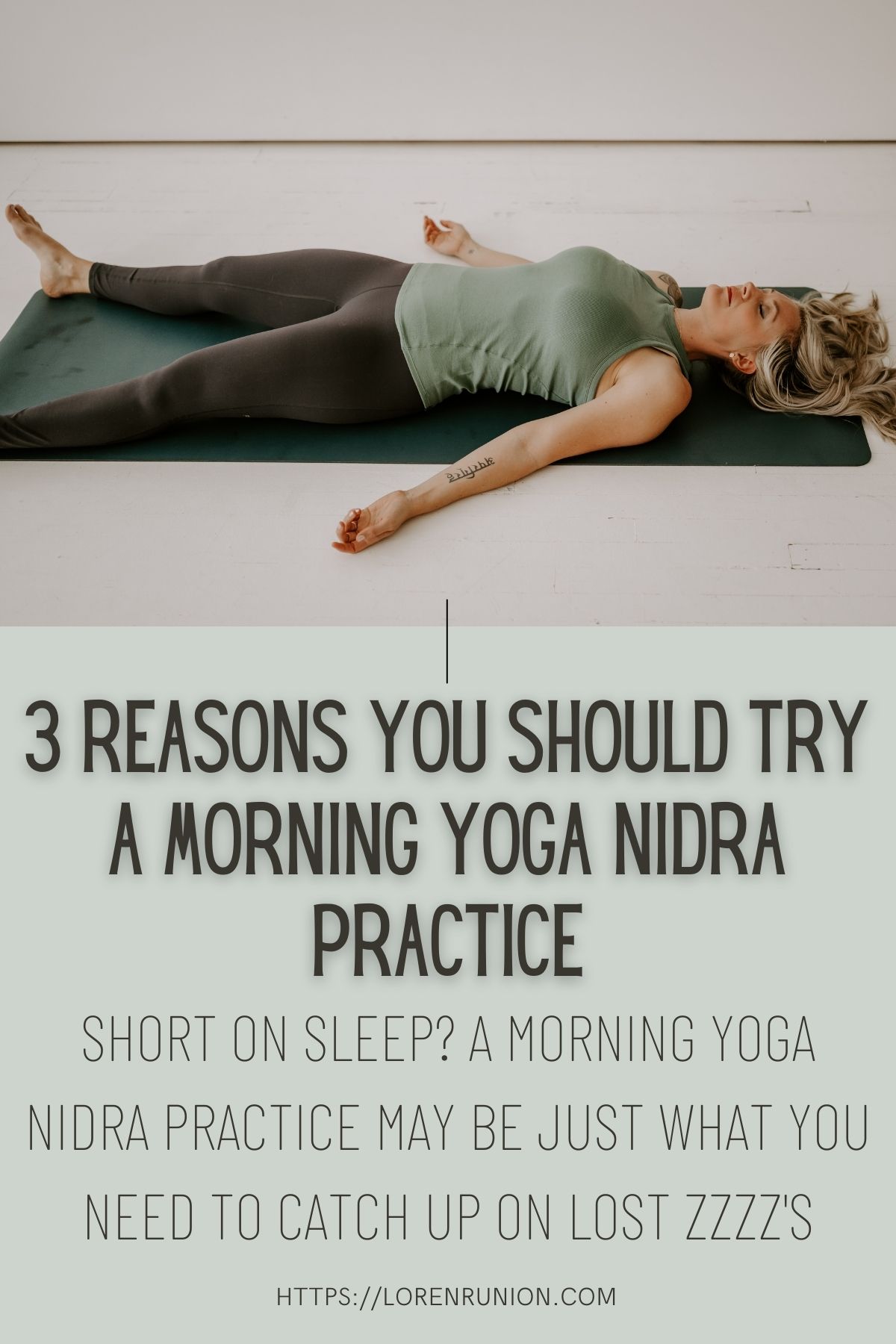
3 Benefits of a morning yoga nidra practice
You might really enjoy a morning yoga nidra practice if you resonate with the following:
Catching up on poor sleep quality
- If you are someone who struggles with waking up tired from poor sleep quality or not enough hours of sleep, a morning yoga nidra practice can help you feel more refreshed. This concept was introduced to me by a colleague and fellow yoga nidra instructor Alex Chaffanjon. Alex is a sleep and rest coach for moms and she shared how a morning yoga nidra practice can really benefit those who have trouble sleeping at night. You can hear the podcast episode here.
- I gave this a try after her advice and here is what I did:
- After a night of super crappy sleep as soon as I decided to “wake up” I stayed in bed and practiced a yoga nidra. So before you even rise or start your morning routine you will practice with your favorite audio or self-guided practice.
- I have to agree it works. While I didn’t feel like I went as deep in the practice since I just woke up, I did feel like I was more refreshed and ready to take on the day.
Intention for your day
- Having a morning yoga nidra practice can help you set the tone and intention for your day. Yoga nidra uses the power of a sankalpa for intention. This intention is planted deeply into the subconscious mind where you start to create change at the root. Practicing yoga nidra at the start of your day is like setting an intention in the most powerful way, programming your subconscious mind to create exactly what you want.
- Think about how you want your day to go. What intention can you set in your practice that will help you align with the life you are trying to create?
- Once you practice your yoga nidra really feel into what it felt like in your practice so that you can carry the frequency of your intention with you the remainder of the day.
A clear mind and calm state
One of the things I hear the most for feedback on my morning yoga nidra offerings is that the practice really helps people clear their mind.
Often times we wake up with an onslaught of thoughts, worries about the day, and stressors to come. Starting your morning with yoga nidra can help you release thoughts that are not serving you, find clarity, and reach a calm state to start your day.
The popular meditation below might be a great place for you to start your morning yoga nidra practice. This meditation is known for helping people really calm down their thoughts.
Try this 10-minute morning yoga nidra meditation
How to have a great morning yoga nidra practice
Keep these tips in mind to have the best morning yoga nidra practice:
- Get REALLY comfortable: Getting comfortable is the most important thing you can do to have a great yoga nidra practice. Traditionally the practice is done laying down in savasana or corpse pose. But this doesn’t mean you can’t find a position that works best for you. You can try an inclined position, lying on your couch, your favorite recliner, side lying, or even your belly. Support all of your joints with things you have access to like pillows, blankets, towels, couch cushions, rolled-up t-shirts, socks etc. Places to pay attention to include the back of your head, shoulders, lower back, hips, knees, and ankles.
Included in seeking comfort for your yoga nidra nest is wearing comfortable clothes, considering something to cover the eyes to block out light like a yoga eye pillow or light fabric or even keeping the eyes open in a soft gaze if closing the eyes doesn’t work for you.
- Stay warm: Consider using a blanket to cover up with to keep you warm in your practice. Because yoga nidra takes you into the states of sleep, your body drops its temperature as it goes into sleep states. You may be more comfortable if you use a blanket that works for the current climate you are in. If you have one you can even try a weighted blanket to see how you like that for your practice.
- Try headphones: I find it helpful to use headphones when following an audio. You can even use noise-canceling earbuds/headphones if you are self-guiding your practice.
- Find a length that works for you: There is no rule that says you have to practice for 30, 60, or even longer minutes to have benefits from your practice. You can feel better from just 10 minutes of yoga nidra in the morning. It is better to show up consistently than to only randomly practice when you can do an hour of yoga nidra.
Yoga nidra in the morning offers a plethora of benefits, making it an excellent way to start the day with a clear and focused mind, improved emotional well-being, and a heightened sense of overall vitality.
Let me know if you give it a try or join me on YouTube for free yoga nidra practices that help you improve your life thru yoga nidra meditation.
Interested in 1-1 yoga nidra sessions? Yoga nidra tailored to exactly what you want to create in your life can help you reach your goals faster. Come find out more information about how 1-1 yoga nidra meditation sessions can help you.


